
Rolls-Royce (LSE:RR) has been a stock market darling for over three years now. The share price chart looks like a plane taking off from a runway, powered higher by Rolls’ mighty growth engines.
Today (26 February), the ascent continued, with the FTSE 100 stock climbing 6% to almost 1,400p after barnstorming 2025 earnings results.
Here are three key reasons why Rolls-Royce continues to demolish your average stock.
Image source: Getty Images
Bulldozing already ambitious targets
Since CEO Tufan Erginbilgiç took the helm at the start of 2023, the turnaround in financial performance has been stunning.
| FY 2023 | FY 2024 | FY 2025 | |
| Revenue | £15.4bn | £17.85bn | £20.06bn |
| Underlying operating profit | £1.59bn | £2.46bn | £3.46bn |
| Underlying operating margin | 10.3% | 13.8% | 17.3% |
| Free cash flow | £1.28bn | £2.42bn | £3.27bn |
At its capital market day in November 2023, Rolls set a medium-term (2027) target for operating profit of £2.5bn-£2.8bn, with a margin of 13%-15%. And it was aiming for free cash flow of £2.8bn-£3.1bn.
These targets were considered ambitious at the time. But as we can see above, Rolls-Royce has made mincemeat of those by beating them two years early.
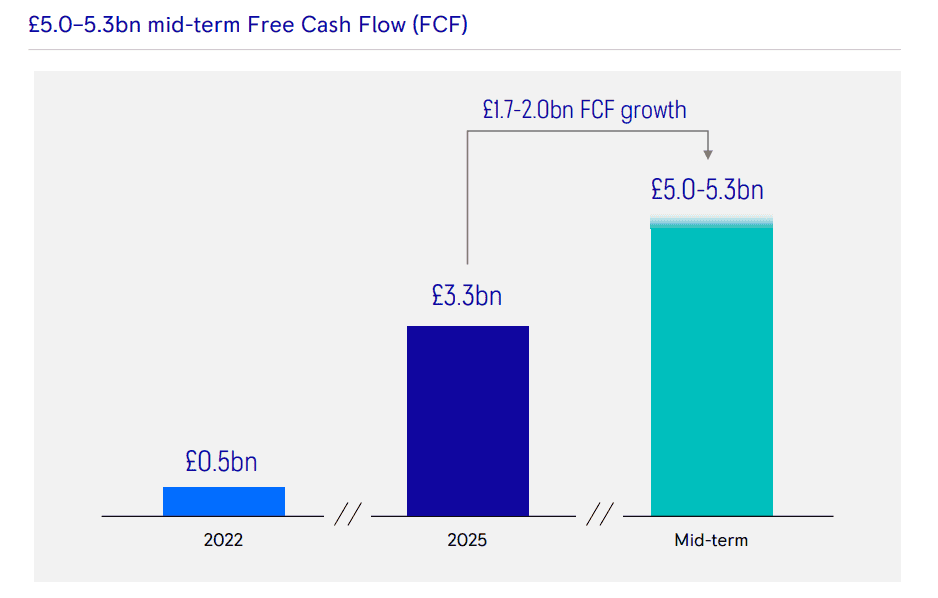
It has now upgraded the targets to £4.9bn-£5.2bn underlying operating profit, an 18%-20% operating margin, and £5bn-£5.3bn in free cash flow. This is expected to be achieved by 2028.
Meanwhile, the return on capital progress has been amazing. From an original medium-term target of 16%-18%, the new goal is 23%-26%.
Erginbilgiç commented: “Our transformation continues with pace and intensity. We are consistently achieving outcomes that were not possible before our transformation.” You can say that again.
Needless to say, this type of outperformance is very rare — and catnip for explosive share price returns.
All divisions are firing
Another key element here is that all three of Rolls-Royce’s divisions are enjoying tremendous momentum.
In Civil Aerospace, where its engines power Airbus 350s and Boeing 787s, renegotiated service agreements, robust travel demand, and time-on-wing extensions are driving significant growth.
The underlying operating margin of 20.5% was up from 16.6% in 2024, while engine flying hours should reach 115%-120% of pre-pandemic levels this year.
In Defence, there was strong growth in transport, naval, and helicopters. However, the unlikely star of the show recently has been the Power Systems unit. Here, Rolls is enjoying surging demand from the global data centre buildout to support the AI revolution.
Power generation revenue jumped 30% year on year, while the order backlog grew 25% to £6.1bn. The unit’s profit surged 60%!
The magic sauce
Rolls-Royce has managed to do what Nvidia couldn’t — engineer a share price bounce following results. The share buyback provided the magic sauce for today’s surge to fresh highs.
Chris Beauchamp, chief market analyst at IG.
Prior to today’s release, Sky News reported that the engine maker was preparing to announce a share buyback worth up to £1.5bn. Well, as is the way with Rolls-Royce these days, this was also underestimated.
Instead, it will spend a total of £7bn-£9bn on share repurchases from 2026 to 2028, with £2.5bn coming this year. Dividends are back too, though the yield on new money is minuscule.
Now, as exciting as all this undoubtedly is, it’s worth pointing out the sky-high valuation here. The stock’s trading at 47 times earnings, so any earnings slip-ups will be punished by the market.
Can Rolls-Royce move even higher? I don’t see why not after these blockbuster results. But I’m looking at other, less expensive, UK stocks right now.